
Note: This article is for meal prep. If you're prepping for a special occasion, click here.
Congrats — your proposal got approved. Now the real work starts.
Most chefs we work with come from restaurants. You already know how to cook. The hard part of being a personal chef is everything around the cooking: the relationship, the prep, the communication, the expectation-setting.
This playbook is built from conversations with Sous chefs who consistently retain clients service after service. If you do these things on service one, you set yourself up to keep that client for months — or years.
The mindset shift (read this first)
In a restaurant, you make the food and the customer comes to it. In someone's home, you make the food to them. They get to decide what's "right."
That doesn't mean lowering your standards. Your standard is now their happiness, not technical execution. The family that wants chicken and broccoli every week isn't wrong. The kid who only eats buttered pasta isn't a problem to solve. That's the job.
"You kind of have to put aside some version of perfectionism. This is what they're eating in their house every day." — Chef Carson Timmerman, Chicago
Approach the relationship like a close coworker — not a friend. You're collaborating with them on something personal in their home. That framing keeps the dynamic warm but professional, which is exactly where you want it.
If you can't make this switch, the rest of the playbook won't save you.
Intake: before you even confirm the menu
1. Over-communicate. Ask about everything.
The biggest mistake new chefs make is showing up without enough information. By the time you're cooking, the first service should feel like you've already met three times.
Cover at minimum:
- Allergies and dietary restrictions
- How they like to eat — soup as a main? Protein + carb + veg every meal? Adventurous or familiar?
- Kid preferences — especially picky ones
- Grocery preferences — store, budget, anything you should source elsewhere (we go deeper in #4)
- Containers — most clients have them. If not, offer to source glass containers and add to the grocery bill.
You can never know too much. If a question feels silly, ask it anyway.
2. Get a video walkthrough of the kitchen
This is the highest-leverage thing you can ask for. Photos help, but a video tour is gold:
- Have them open every cabinet and drawer
- Show the pantry and spice rack
- Open the fridge and freezer
- Show the oven, cooktop, and any appliances
- Call out anything that's broken, finicky, or runs hot/cold
You'll learn in three minutes what would otherwise take three services to discover. If their kitchen is missing equipment you'd normally rely on — a blender, a stand mixer, sheet pans — you'll know to bring your own.
3. Send menu options, not a final menu
Talk to your client about optionality. How many options do they want you to send each week?
Most clients are busy and don't want to spend too much time thinking about the menu. If they need 3 meals, you might give them 4 options to choose from for example. Always consider who the client is (tastes, preferences, etc.) and what they've eaten recently.
If nothing on your list excites them, that's important information. Better to know now than three services in.
The day before: prep and expectations
4. Groceries: get on the same page
Groceries are a pass-through — you don't profit from them. Which means the client's grocery bill is something you can actively help them manage, not something you absorb in silence. The chefs who retain clients longest treat the grocery conversation as collaborative from day one.
Ask what they want to spend. Before you send your first grocery list, ask the client what they're hoping to spend on groceries each week. Don't guess. Most clients have a number in their head — get it on the table early.
Match the menu to the budget. If they want to keep groceries around $150/week, that's a different menu than $300/week. Same number of meals, different protein choices. Chef Wes Hill puts it this way:
"I had a client cutting his order down over a few weeks. I asked why — turned out he was trying to save money. I told him: 'You can keep the same number of meals. I'll switch from Chilean sea bass to salmon, from filet to flank steak. Your bill goes from $300 to $170.' He didn't have to lose meals to save money — he just needed to know the trade-off."
Send a detailed grocery list before service one. Go granular — not just ingredients, but foil, salt, pepper, oil, the kind of salt they use, anything you'll need from their kitchen.
Then set the cost expectation directly:
"Your first grocery bill will be the highest one. We're stocking the pantry — basic spices, oils, vinegars, anything that'll last us months. Your future bills should be noticeably lower."
This combination — asking what they want to spend, matching the menu to it, and explaining why the first bill is a one-time spike — prevents one of the most common reasons clients don't book a second service: sticker shock on groceries.
5. Pack smart — bring what you'll need, but don't over-pack
Bring backup tools. Always bring towels. You never know what they don't have.
But also: don't haul your entire kitchen across town to a fully-stocked house. If the video walkthrough showed they have a stand mixer, sheet pans, a Vitamix, and every spatula known to humankind — leave yours at home.
If their kitchen is missing something you'll need (like a blender or a food processor), bring yours.
6. Print our reheat & feedback sheet — bring one to every service
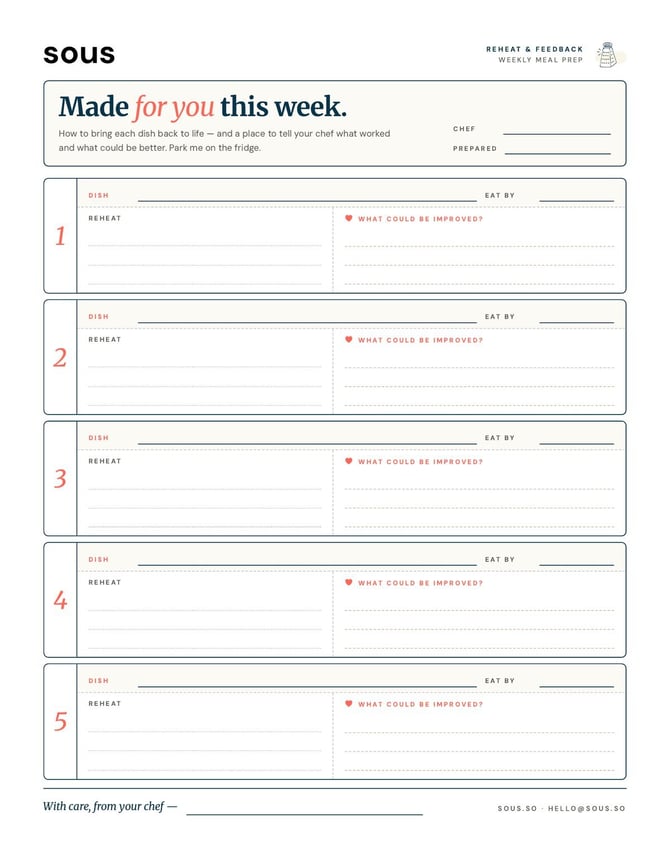
This is one of the highest-impact things you can do. We built a one-page reheat and feedback sheet you can download, print at home, and fill out at the end of each service. Five dish slots, space for reheat instructions, and a row per dish for the client to write back what worked and what didn't.
[Download the Sous reheat & feedback sheet (PDF) →]
How to use it:
- Print one (or two) on regular printer paper before each service — no special paper or duplex needed
- Fill it out by hand at the end of the cook: dish name, eat-by date, reheat instructions
- Walk the client through it before you leave (see #13)
- Tell them: "Anyone in the house can write feedback right on the sheet — your partner, the kids, the nanny. I want to know what worked and what didn't."
- Suggest they stick it on the fridge with a magnet
- Check in mid-week or before the next service to see what they wrote
Why it matters:
- Anyone in the household can use it — kids, au pair, nanny, partner. Not just whoever is on the app.
- It doesn't get buried in a text thread.
- The feedback is a system, not a hope. You'll actually get useful data on what worked.
- It feels personal. They walk into the kitchen after you're gone and see it waiting for them on the fridge.
"My clients have the kids, the partner, the nanny — they all eat the food. A printed sheet on the fridge means everyone sees the reheat instructions, and anyone can write down what they thought. It's not just for whoever's on the app." — Chef Keenan Brackett, Chicago
On site: during the service
7. Be conscious of time and space
You are a guest in a home where people are actively living. The nanny is coming at 1:30. The kids get home from school at 3. The husband has a Zoom call at noon in the room next to the kitchen. Stay aware of all of it.
Some clients will sit at the island and chat with you for hours. Others want you to be invisible. Read the room and adjust.
Either way, work efficiently and stay out of the way. The more organized you are, the less you intrude.
8. Plan your work order
Restaurant chefs already think this way, but it's worth being explicit. A rough sequence that works:
- Bake first — longest cook times, frees the oven for other things
- Roast second — also oven-bound, runs while you're working on stovetop
- Stovetop proteins and grains — middle of the service
- Sides last — usually fast, easy to cool down quickly and pack
This keeps you efficient and ensures everything is ready to cool and pack at roughly the same time.
9. Be warm. Be normal.
You're in someone's home. Around their kids. Often their pets. Closer in spirit to a trusted household help than a line cook.
You don't have to chit-chat the whole time — most clients want you focused. But be open and friendly when they pop in. Talk to the kids. Acknowledge the dog. The better the rapport, the more fun the job is for both of you.
The chefs who retain clients longest are the ones whose clients feel comfortable saying "hey, that one wasn't our favorite." That only happens if the relationship feels easy from day one.
10. If you notice something off, say something immediately
The oven knob is loose. There's a stain on the counter you didn't make. A glass breaks. Tell the client right away — even if you didn't do it.
This builds enormous trust. If something looked weird and you said nothing, then later they notice it themselves, you're suddenly under suspicion. If you flag it the moment you see it, you're the chef who's honest and observant.
11. Teach as you go
You're not just cooking — you're a food expert in their kitchen. Share what you know:
- Why this container works better than that one for this dish
- Which things hold for four days vs. need to be eaten by day two
- Why the dressing shouldn't be mixed with the salad until serving
- How to par-cook something so they can finish it fresh later
Clients who feel like they're learning from you see more value in the service. That's what makes the subscription worth keeping.
12. Leave the kitchen cleaner than you found it
Especially on service one. You don't know their standards yet, so default to spotless. Wipe everything down. Take out the trash. Run the dishwasher.
Over time you'll learn what they actually care about. For the first service, leave no doubt.
Wrap-up: before you leave
13. Walk them through the food
Use the reheat sheet from #6 to walk them through the food. Point out:
- What to eat first vs. what holds longest
- Anything that needs special handling
- Anything you par-cooked that they'll finish on their own
The worst outcome is that you cooked something perfectly and they microwaved it into rubber, then decided your cooking was the problem. Two minutes of walkthrough prevents that.
14. Invite honest feedback
Even with the feedback sheet on the fridge, say it out loud: "I want to know what you loved and what you didn't. Don't be polite about it — I'd rather know."
"Most people don't want to give negative feedback. You have to really ask for it — say 'I won't be offended, just tell me.' Once you hear them and adjust, they'll never forget it." — Chef Wes Hill, New York
You can't course-correct on what you don't know. Set the tone now.
Ongoing: from service one to service two and beyond
15. Set a menu cadence and stick to it
Give clients a clear lead time so you have enough runway to source groceries. A common rhythm:
- Send next week's proposed menu by a fixed day each week (2-3 days before service)
- Give the client a defined window to respond
- Confirm the final menu in writing
- Source groceries the day before
Pick the cadence, communicate it, and hold to it.
"I never miss a Friday. Every Friday before noon, the menu goes out. The predictability builds trust before the food does." — Chef Wes Hill, New York
16. Treat freelance like a real job
A lot of chefs come into this thinking I'm my own boss, I'll set my own pace. Then menus go out late, texts go unanswered, and clients quietly drift.
Build systems:
- Pick a day each week for menu planning
- Reply to messages promptly
- Show up on time, every time
- Communicate proactively when anything changes — yours or theirs
Clients pay for reliability as much as for cooking. Most retention is lost on the operational side, not the food.
17. Know what's not your job
You're a chef, not a nutritionist. If a client wants a custom macro-balanced plan for a health goal, that's outside your scope. Pretending otherwise sets up a relationship that won't end well.
The right answer: "If you have a plan from a nutritionist, I'm happy to cook within those constraints. But I'm not the person to design the plan."
Be clear about what you do and don't do. Clients respect it.
The short version
- Make the mindset shift — restaurant chef to personal chef, close coworker not friend
- Over-communicate before service one — ask everything, including grocery preferences
- Get a video walkthrough of the kitchen
- Send menu options
- Get on the same page about grocery budget — match the menu to what they want to spend
- Pack smart — backup tools and towels, but don't over-pack
- Print and bring the Sous reheat & feedback sheet to every service
- Be conscious of time and space in their home
- Plan your work order (bake → roast → stovetop → sides)
- Be warm and normal
- Flag anything off the moment you notice it
- Teach as you cook
- Leave the kitchen spotless
- Walk them through the food before you leave
- Invite honest feedback directly
- Set a menu cadence and stick to it
- Treat freelance like a real job
- Know what's not your job
Do these on service one and you won't just have a client. You'll have a repeat client. That's the entire game.
Questions? Text Craig directly — happy to talk through any of this before your first service.